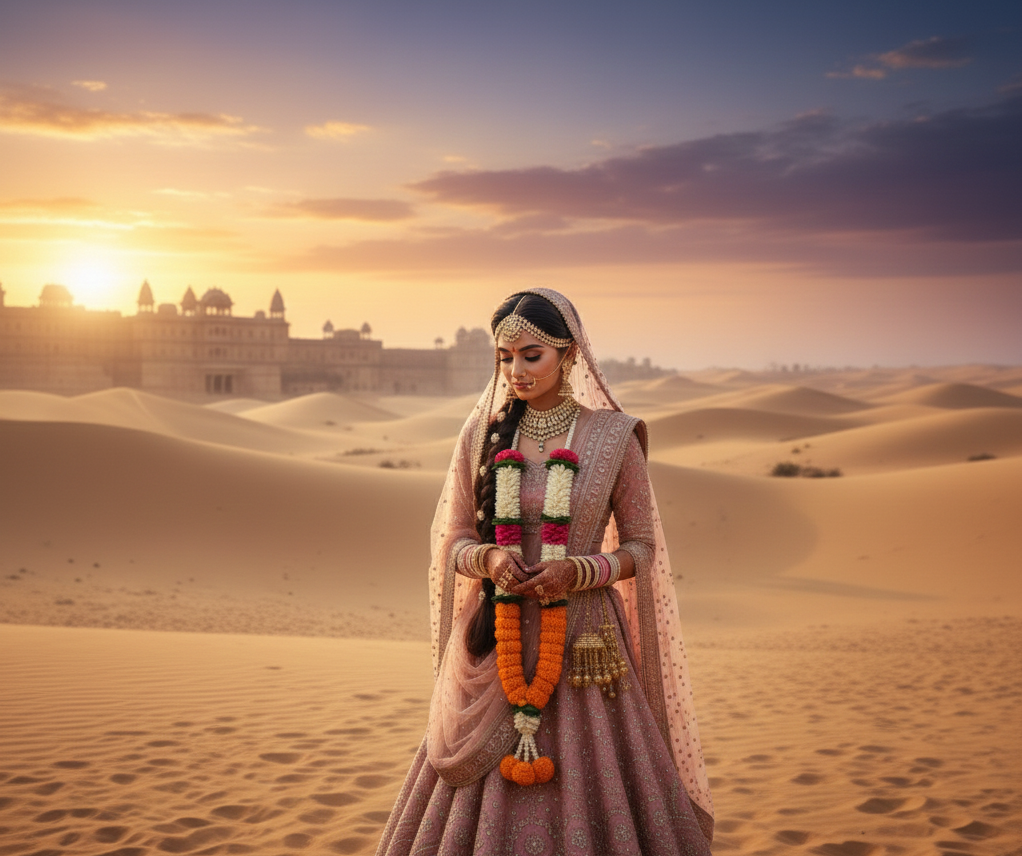
Rajasthani folk songs express a form of love that is quiet, contained, and deeply rooted in dignity. It does not announce itself through grand gestures or open declarations. Instead, it lives in silence, patience, and emotional depth. These songs come from a time when women often lived in their in-laws’ homes, always draped in poshākh or saree, faces veiled from strangers, and feelings carefully guarded. Yet within these limits, marital affection thrived—full of longing, respect, and an unspoken bond.
A single couplet captures this sensibility with striking simplicity:
“साजन गली सँकड़ी तो सामना मिल गया सैं,
हँसया पर बोल्या नहीं, म्हारा नीचा कर गया नैन।”
The lane is narrow; there is no way to avoid crossing paths. The husband smiles but does not speak. The wife responds by lowering her eyes. No words are exchanged, yet everything is understood. Love here is not declared—it is acknowledged through conduct.
Across Rajasthani folk traditions, the wife never takes her husband’s name. He becomes Sajan, Balma, Bhartar, Pihūji, or Baisa ra Beera. This absence of naming is not distance, but reverence. The bond is so complete that identity is implied, not spoken. Respect itself becomes the language of closeness.
The well-known narrative of Moomal and Mahendra occupies a special place in this tradition. Though their story is shaped by destiny and separation, the emotional tone remains refined and restrained:
“लिख्या विधाता लेखड़ा, मूमल राणा महेंद्रां।”
Fate itself is said to have written their bond. Moomal’s longing is not loud or bitter; it is steady, dignified, and deeply felt. When she calls out:
“अरे राणा राणा ओ रे…”
it is an invocation filled with remembrance and devotion, not complaint. The folk imagination presents her as emotionally rich yet composed—never crossing into accusation or despair.
This inner discipline becomes even more visible in moments of separation. One poignant couplet says:
“सजना यूँ मत जणियो, थां बिछड़्यां मोहे चैन,
जैसे जल बिना माछली, तड़पत रई दिन रैन।”
Here, the wife asks her husband not to assume she is at peace while apart. Without him, she is like a fish without water—restless day and night. The pain is honest, yet expressed with humility. Longing is voiced, but dignity remains intact.
Nature often carries what words cannot. Clouds, stars, and evening become emotional companions:
“दल बादल बीच चमक्या जी तारा,
सांझ पड़या पिहूजी लागे ओ प्यारा।”
As dusk falls and a star glimmers between clouds, the beloved feels nearer. Time itself becomes a vessel for feeling.
Among the most evocative symbols in these songs is the kurjan, the demoiselle crane. When the woman cannot travel or speak freely, the bird becomes her messenger. In a deeply moving image, she says:
“चोंच ऊपर लिखण गोरी हांजी ओलमा,
पंखडिया पर लिखा सात सलाम,
कुरजां रे म्हारो भंवर मिलाई दिज्यो आज।”
She imagines writing her complaints on the bird’s beak and inscribing seven salaams—seven praises of her husband—on its feathers, so that when the kurjan reaches him, he receives both her pain and her reverence together. Even her grievances travel wrapped in honor. Praise and longing move side by side, never one without the other.
Gentle hesitation also finds its place:
“काईं रे जवाब करूं रसिया,
ओ कीसो रे मिजाज करूं रसिया।”
Here, the wife pauses—not because she lacks feeling, but because feeling is too precious to release carelessly. Silence again becomes expression.
What is striking in these folk traditions is what they do not contain. There is no bitterness, no betrayal, no rancor. Separation does not turn into resentment. Love remains steady, even across distance. The woman waits, sings, remembers, and trusts.
Closing: When Silence Becomes Expression
Together, the narrow lane, the lowered eyes, Moomal’s remembered call, the evening star, the kurjan, and the seven salaams form a complete emotional grammar. These symbols allow marital love to exist fully without ever crossing dignity. Rajasthani folk songs remind us that affection does not need display—it needs , patience, respect, and depth, virah bhaav. In their quiet strength, these songs preserve a timeless understanding of companionship that endures without raising its voice.
Few Song References:
- Moomal Mahendra Lok Katha
- Kurjan Re Bhanvar Milai Dijo aaj
- Dal Badal Bich Chamkya Ji Rara
- Ave Ni Punnale Ri Olyundi