Understanding Rajasthani Folk Songs Beyond Translation
Rajasthani folk songs are not built on melody alone. They stand on a carefully regulated vocabulary shaped by kinship rules, caste structures, migration, devotion, and gender etiquette. Many words that appear repeatedly in folk songs are not interchangeable with Hindi. Translating them loosely does not simplify meaning — it erases cultural intelligence.
This blog introduces a small but important set of such words, showing how and why they are used, and what collapses when they are misunderstood.
Speaking of the Spouse Without Naming Them
One of the most misunderstood expressions in Rajasthani folk is “Baisa Ra Beera / Nanad Ra Beera.”
Literally, these mean:
- Baisa Ra Beera — brother of my husband’s sister
- Nanad Ra Beera — brother of my sister-in-law
Culturally, both mean: husband, referred to indirectly.
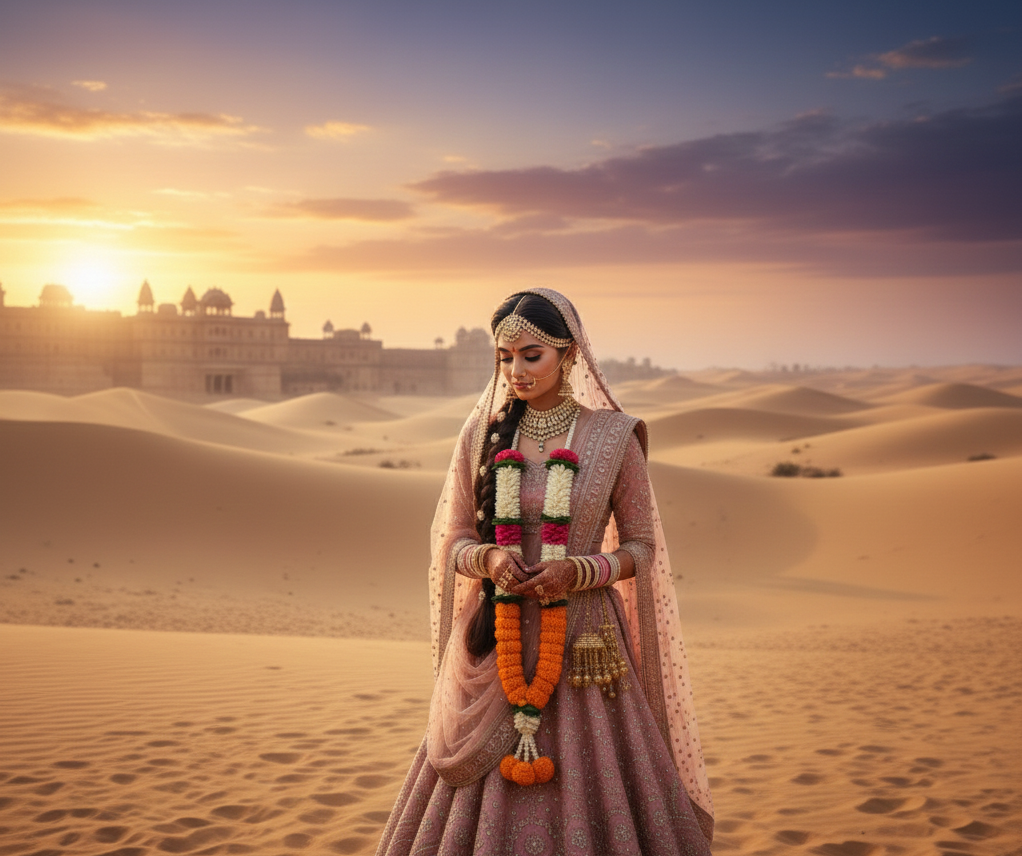
In traditional Rajasthani society, a wife does not take her husband’s name. Direct naming is considered socially improper. Instead, she speaks through kinship geometry. When a song says:
“Kurjan, mharo bhanwar milai dijo aaj…”
the word bhanwar (husband, groom) is itself respectful and elevated — and often still avoided directly in favor of kinship terms like Baisa Ra Beera. Emotion is expressed through restraint, not declaration.
Respect Is Mutual: Husbands Also Avoid Names
An often-missed detail: this restraint is not one-sided.
In many Rajasthani folk songs, husbands also do not call their wives by personal names. Instead, they use respectful, affectionate terms:
- Gori – fair one, dignified wife
- Sundar Gori Re – beautiful, virtuous wife
- Bhartari – wife, partner in life-dharma
These are not casual endearments. They acknowledge the wife’s status, grace, and role, not possession. Folk songs preserve a world where intimacy exists without verbal exposure.
Words Used for Husband: Nuance, Not Redundancy
Rajasthani folk uses multiple words for “husband,” each carrying contextual weight:
- Bhanwar / Bhanwar Sa – groom, noble husband
- Dhola – fair, cherished husband (often in virah)
- Balma – beloved, emotionally close
- Sajna / Sajna Sa – affectionate, intimate address
These are not synonyms. A woman waiting uses dhola or balma; a celebratory song uses bhanwar sa. Vocabulary shifts with emotion.
Identity Through Lineage, Not Personal Names
Women in Rajasthani folk are often identified through marital lineage, not individual naming:
- Rathodi – wife of a Rathore
- Bhatiyani – wife of a Bhati
- Sisodini – wife of a Sisodia
These are honorific identities, not surnames. They embed the woman within historical memory, sacrifice, and clan ethics, preserving dignity through anonymity.
Birds That Carry News, Not Decoration
Birds in Rajasthani folk are narrative agents, not ornaments.
Kurjan (Demoiselle Crane) is addressed directly because it migrates vast distances. A woman sings:
“Kurjan, mharo bhanwar milai dijo aaj…”
The bird becomes a bridge between separated lives. Translating kurjan as merely “a crane” removes its emotional function.
Similarly:
- Mor / Morni (peacock) appear with rain, desire, fertility.
- Koyal (cuckoo) sharpens longing by announcing spring without reunion.
Seeing, Waiting, and the Weight of Time
Rajasthani has layered words for “seeing”:
- Dekhan – to see
- Takni – to look repeatedly
- Nirkhan – to gaze with devotion and waiting
When a song says a woman nirkhe raah, it implies seasons of waiting, not a glance. Time itself is encoded in the word.
Memory That Hurts: Olyundi and Birah
Olyundi is not simple memory. It is ache-filled remembrance, often surfacing during routine tasks or silence.
Birah (Virah) is not mere separation. It is a sanctified emotional state, where longing becomes endurance. Folk tradition treats birah as transformative, not tragic.
Color as Prayer, Not Description
When songs praise Kesario Bano or Hariyalo Bano, color becomes spoken blessing:
- Kesario (saffron): valor, survival
- Hariyalo (green): fertility, continuity
Women sing color to protect the absent husband.
Devotional Vocabulary: Folk Spiritual Intelligence
Rajasthani folk seamlessly blends devotion with daily life:
- Guru – not teacher, but spiritual axis
- Jhini Jhini – subtle, layered, between-the-lines knowledge
(like maheen in Urdu, but spiritually coded) - Gorja / Gauri – Parvati as nurturing Shakti
- Bholanath – Shiva in his compassionate form
- Maay / Maayad / Maa – Shakti, not just mother
When a song speaks of jhini jhini baat, it refers to wisdom given indirectly, often by the Guru — knowledge felt, not announced.
Why This Vocabulary Matters
Rajasthani folk songs do not explain emotion. They encode it through:
- kinship discipline
- mutual respect between genders
- historical absence and migration
- devotional subtlety
Replace these words casually, and the song survives — but the culture does not.
A Closing Note
This list is very small — just a drop in the ocean of Rajasthani folk vocabulary.
If you know a word and want to share its meaning,
or want to understand a word you’ve heard in a song,
just comment below.
Folk knowledge survives only when it is spoken, questioned, and remembered.